Paint Coverage Calculator: How Much Paint Do I Really Need?
Stop guessing paint quantities. Learn the coverage formula, understand what affects coverage, and calculate exactly how much paint you need for any room.
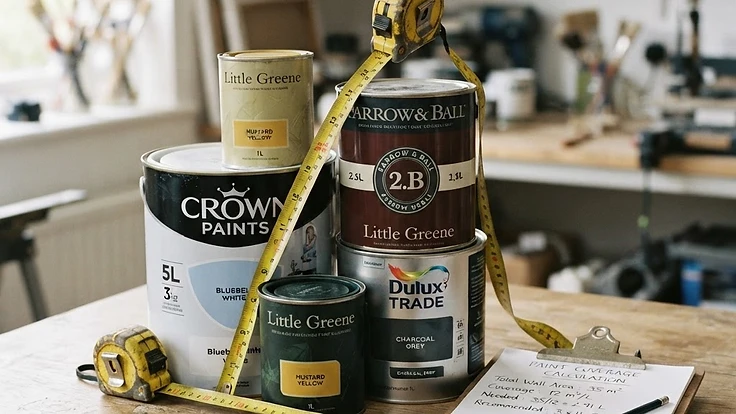
The Most Common Question in Decorating
"How much paint do I need?" is the question every decorator asks at the merchant's counter — and the one most often answered with a shrug and a guess. Buy too little and you're making a second trip mid-job. Buy too much and you're wasting money on paint you'll never use.
The good news: calculating paint coverage is simple maths once you know the coverage rate of your product and the surface area you're painting.
Understanding Paint Coverage Rates
Coverage is always stated on the tin — usually as square metres per litre (m²/L). Here are typical coverage rates for common product types:
- Emulsion (matt, eggshell, silk): 12–16m² per litre on smooth plaster
- Primer/undercoat: 10–14m² per litre
- Gloss and satinwood: 14–18m² per litre on prepared wood
- Masonry paint: 4–6m² per litre (much thicker product)
- Specialist ceiling paint: 14–17m² per litre
Coverage drops on rough or porous surfaces. Bare plaster sucks up the first coat — expect 30% less coverage on the first coat of a bare wall.
The Paint Coverage Formula
Here's the formula every decorator should memorise:
Paint needed (litres) = (Surface area ÷ Coverage per litre) × Number of coats
Worked Example: A Living Room
Let's say you're painting a 5m × 4m living room with 2.4m ceilings:
- Perimeter: 5 + 5 + 4 + 4 = 18m
- Wall area: 18m × 2.4m = 43.2m²
- Minus one door (2m²) and one window (1.5m²): 43.2 − 3.5 = 39.7m²
- Ceiling area: 5m × 4m = 20m²
- Total surface: 59.7m²
Using an emulsion with 13m²/L coverage and two coats:
Walls: (39.7 ÷ 13) × 2 = 6.1 litres
Ceiling: (20 ÷ 13) × 2 = 3.1 litres
Total: 9.2 litres — round up to 10 litres
Factors That Affect Coverage
Surface Condition
Bare plaster, new drywall, and previously unpainted surfaces absorb more paint. Budget for 30–50% extra on the first coat. Previously painted walls in good condition will achieve full coverage.
Colour Change
Going from a dark colour to a light one (or vice versa) often needs three coats, not two. A tinted primer in the direction of your topcoat can save a coat.
Application Method
Rolling is more efficient than brushing — you lose less paint to the tray and get more on the wall. Airless spraying uses the most paint but covers fastest. For cutting in, expect slightly lower coverage than rolling.
Product Quality
Cheaper paints often have lower pigment density, meaning you need more coats to achieve the same finish. A premium emulsion might cover in two coats where a budget paint needs three — making the premium option cheaper overall.
Quick Reference: Paint Needed by Room Size
Assuming 2.4m ceilings, two coats of emulsion at 13m²/L, walls only:
- Small bedroom (3m × 3m): ~4 litres
- Medium room (4m × 4m): ~5.5 litres
- Living room (5m × 4m): ~7 litres
- Large living room (6m × 5m): ~9 litres
- Open-plan space (8m × 6m): ~12 litres
Add 30–50% more for bare plaster or dramatic colour changes.
Let the App Do the Maths
Trade Assist's quote builder includes a built-in paint coverage calculator. Enter your room dimensions, choose your paint product, and the app calculates exact quantities — accounting for doors, windows, ceilings, and the number of coats. It even pulls real products and prices from the Topdec catalog, so your material costs are always accurate.
No more guesswork at the merchant's counter. No more wasted paint. No more mid-job supply runs.